Brandon was built in waves, and each wave used the plastic or metal that was common at the time. The Census Bureau’s American Community Survey counts 10,619 of the community’s 48,953 housing units as 1980s construction, which works out to 21.7%. That decade sits squarely inside the years polybutylene went into American houses, so the question of what is behind your walls is not an idle one.
Which Pipe Could Be in Your House
| Built | Share of Brandon units | Supply pipe to check for |
|---|---|---|
| Before 1960 | 2.3% | Galvanized steel, which trade sources call common in homes of that age |
| 1960–1979 | 20.7% | Copper or older steel; polybutylene starts to appear from 1978 |
| 1980–1999 | 41.7% | Polybutylene sits inside this window, alongside copper and CPVC |
| 2000–2009 | 21.2% | CPVC is a likely candidate after an early-2000s Florida code shift |
| 2010 and later | 14.1% | PEX is likely |
Read that table as odds, not an answer. A house built in a given year tells you about the street, not about the pipe, because repairs and earlier repipes change things. The 1978–1995 polybutylene window comes from the Cox v. Shell class settlement, which covered polybutylene with acetal fittings installed between January 1, 1978 and July 31, 1995. That settlement is closed.
How to Recognize Each One
- Polybutylene (PB): flexible plastic, usually gray but sometimes blue, silver or black, stamped with a code such as PB2110. Look where pipe shows: at the water heater, under sinks, at the main shutoff.
- Galvanized steel: gray, threaded, rust-streaked at joints, and often weak in flow because mineral scale narrows the bore.
- Copper: reddish brown, with green crust at fittings. Copper can last decades and can also develop pinholes.
- CPVC: rigid and cream or tan. It entered the national plumbing code in 1978.
- PEX: flexible, color-coded red, blue or white. It first entered a regional model plumbing code in 1997.
One piece of good news: Hillsborough County says homes built after 1981 are unlikely to have lead service lines, and its review of more than 1,400 pre-1982 addresses found none in the South-Central system that serves most of Brandon.
Patch or Repipe: Signs That Decide It
One pinhole in an otherwise sound line is a repair. We open a section of wall, cut out the bad piece and sleeve in new pipe, usually in the $350–$900 range. Repiping enters the conversation when:
- A third pinhole shows up in a year, especially on different branches
- Water pressure and flow drop at several fixtures at once
- Plumbers keep opening walls for leaks in the same run
- Pipe you can see is polybutylene or galvanized and scale-choked
Before you accept a repipe quote, ask whether anyone measured static pressure, because the 80 psi check can change the plan. A leak detection visit runs $200–$450 and is credited toward the repair. A whole-house PEX repipe typically runs $4,500–$12,000 depending on size and access, and anything over about $1,500 deserves a second written quote.
What to Do This Week If You Suspect Polybutylene
- Photograph every piece of supply pipe you can see: at the heater, under the kitchen and bath sinks, at the main shutoff and at the hose bib nearest the house.
- Write down the year the house was built and any repiping, remodeling or leak repairs you know about.
- Measure static pressure with a hose-bib gauge, because pressure drives leak risk in any pipe.
- Learn where the main shutoff is and make sure it still turns.
- Call your insurance agent and ask what they require for your pipe type.
That sequence costs a few dollars and an afternoon, and it gives any plumber who visits a head start. It also keeps you from paying for a camera or a wall opening to answer a question a photograph can answer.
How a Repipe Typically Runs
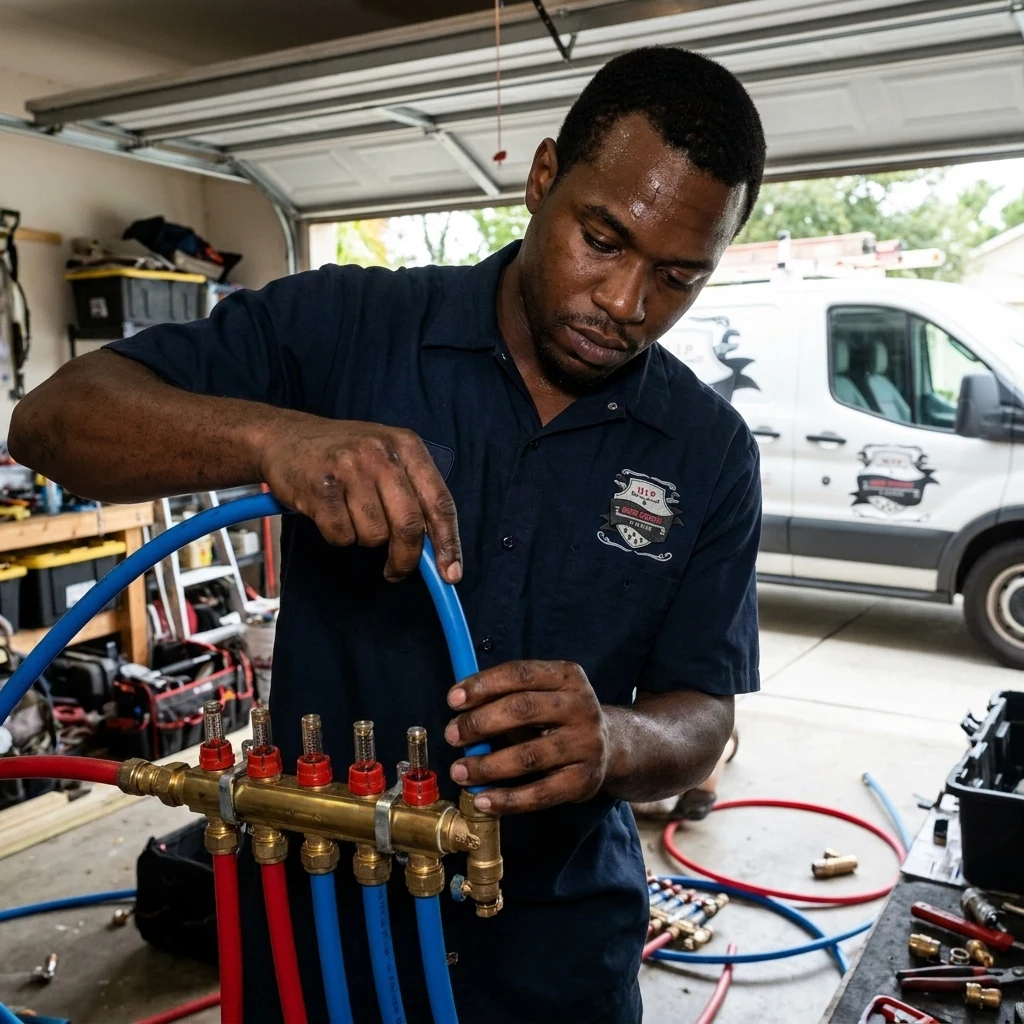
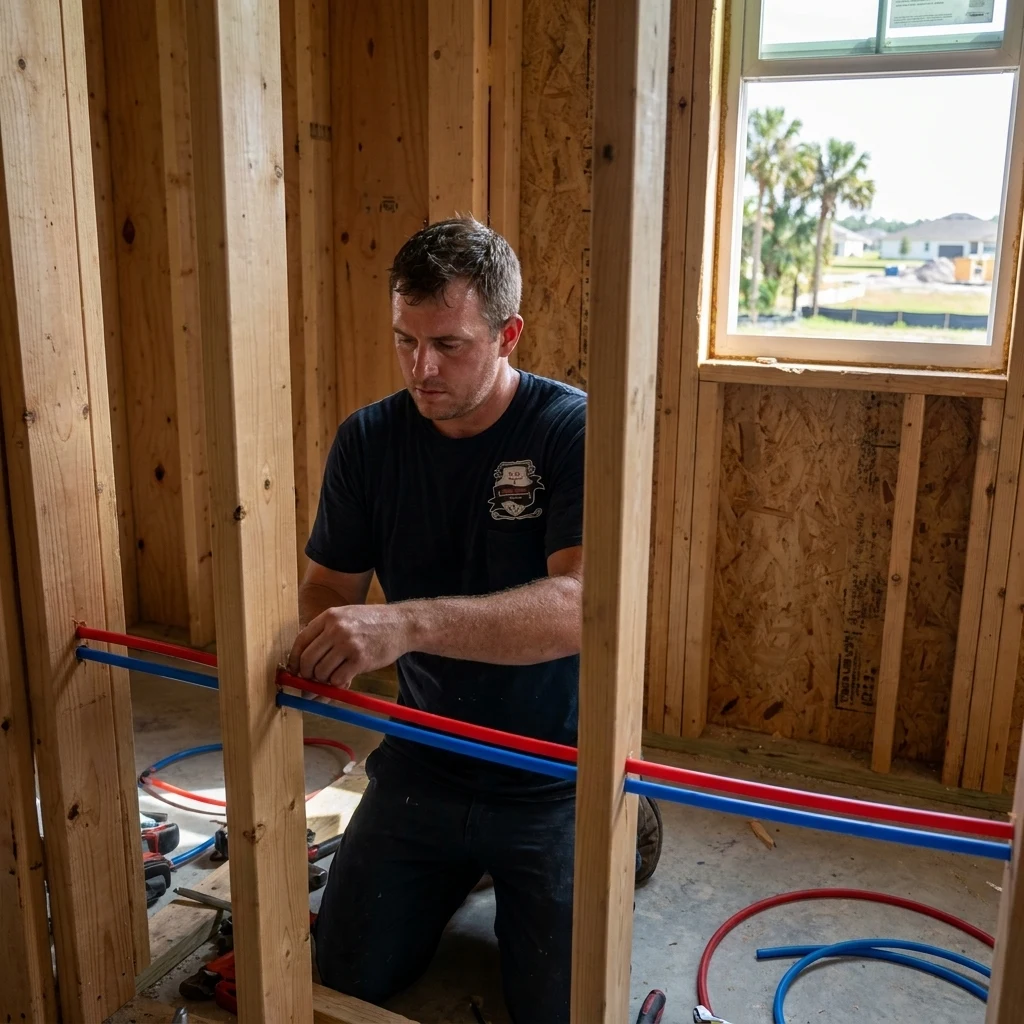
A repipe visit usually starts with a walkthrough to count fixtures and find access through the attic, garage and closets. A written price follows, with the permit line spelled out. On the work day the water goes off, new PEX lines run from a central manifold or a trunk to each fixture, and the old pipe is abandoned or removed depending on access. Lines are tested for leaks before walls close. A plumbing final inspection follows where the county requires one, and then the access holes get patched. Most of the disruption is dust and a day or more without water, and it is worth asking how long the water will be off.
Insurance, Permits and the Mess
Some insurers decline or surcharge homes with polybutylene. We cannot tell you which, so ask your own agent before you decide how fast to move. On permits, the county’s own list says replacing a defective concealed pipe needs one, and its inspection list names a plumbing final for a re-pipe. The quote should say who applies. Access holes cut in drywall need patching and paint, so ask whether those are in the price. Our repiping service page lays out how a PEX job runs from the manifold outward.
For two examples of streets built in the right window to ask the question, read about Heather Lakes and Brentwood Hills. And if you want a calm way to weigh a patch against a replacement, the repair or replace guide walks through it.
Not sure what is behind your walls?
Tell us your home’s build year when you call and we will start with the places where the supply pipe shows.
CALL 813-733-7188Which pipe, and when to repipe
No. Polybutylene was common from the late 1970s into the mid-1990s, so a 1980s house falls in the window, but many were plumbed in copper or CPVC. Look at the visible pipe near the heater and under sinks before you assume anything.
Polybutylene is flexible, usually gray, and stamped with markings such as PB2110. CPVC is rigid, cream or tan, and cut with a solvent-welded fitting. If you cannot tell from a photo, a technician can identify it in seconds at the heater or under a sink.
Typically $4,500–$12,000 for a whole house, depending on size, stories and how easily the attic, garage and closets give access. Anything over about $1,500 deserves a second written quote, and ours is written upfront and honored for 30 days.
The county says replacing a defective concealed pipe needs a permit and lists a plumbing final inspection for a re-pipe. Ask the quote to say who applies. We do not promise fees or timelines here.